Dog Separation Anxiety: Practical Ways to Help Your Dog Feel Safe When Alone
Does your dog panic when you leave the house?
Does your dog bark, howl, pace, scratch at doors, chew furniture, toilet indoors or try desperately to escape whenever you leave?
If so, you may be seeing separation anxiety or separation-related behaviour.
For some dogs, being left alone is more than simply being bored. They can experience genuine fear, distress and anxiety when their person disappears. The resulting behaviour can be upsetting for everyone — and it can sometimes put the dog at risk of injury.
The good news is that many dogs can improve significantly with patience, appropriate environmental management and gradual behaviour modification.
There is no single magic solution. The most useful approach is usually a combination of enrichment, environmental changes, calm routines and carefully controlled periods of separation.
And importantly, most of the strategies discussed here cost little or nothing — although they do require time, consistency and patience.
I have dealt with many dogs of different breeds, ages and backgrounds that have experienced separation anxiety. From a rescue great dane that ate a new sofa to an aged moodle’s behaviour change due to dementia. The information provided in this post gives you advice and solutions that have been tried, tested and worked for me.
Important: Severe separation anxiety should be discussed with your veterinarian or a qualified veterinary behaviour professional. Dogs experiencing extreme distress may need a tailored behaviour plan and, in some cases, veterinary medication. See below for more details on this subject.
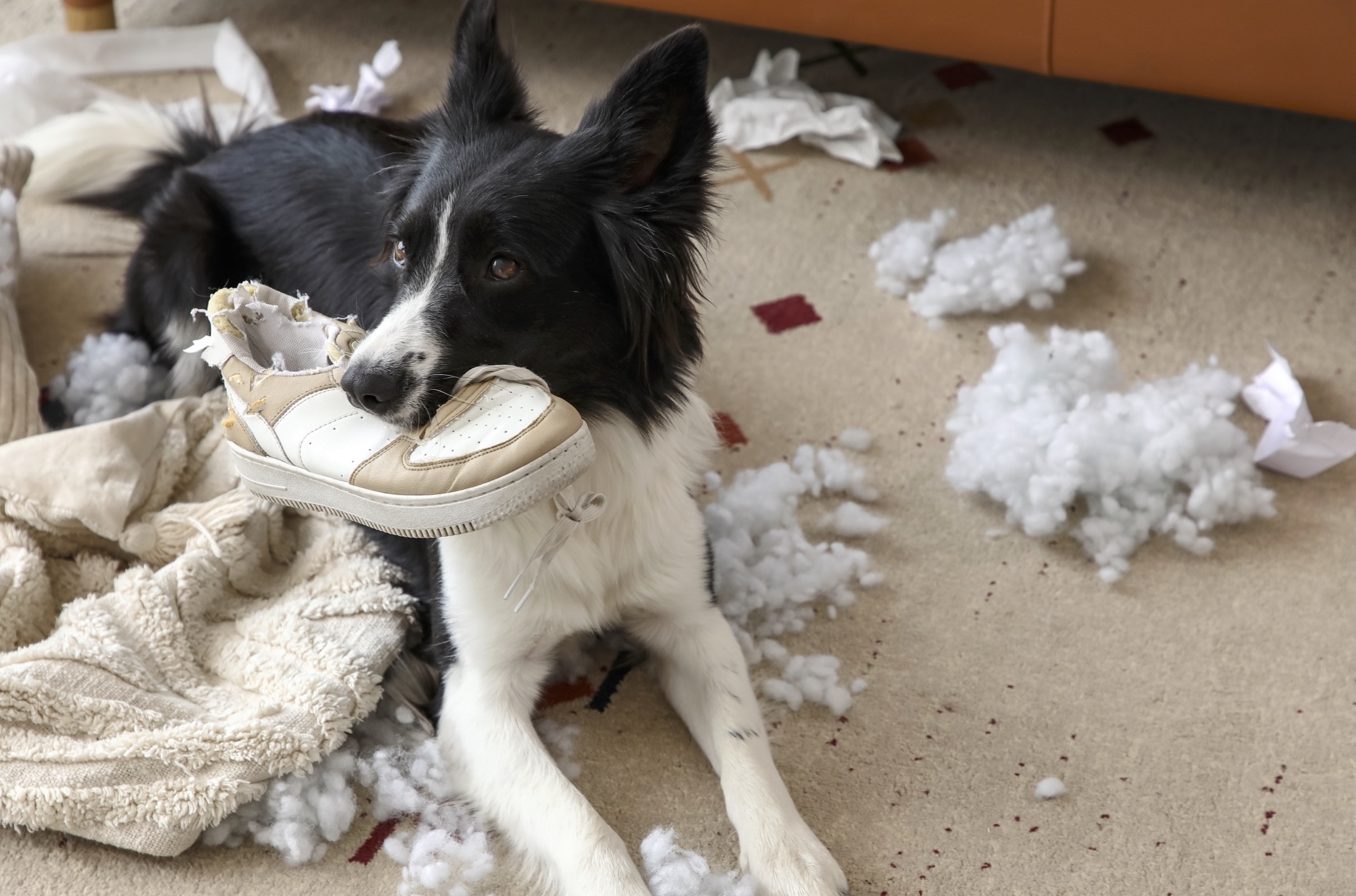
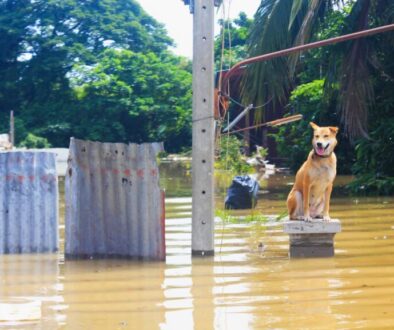
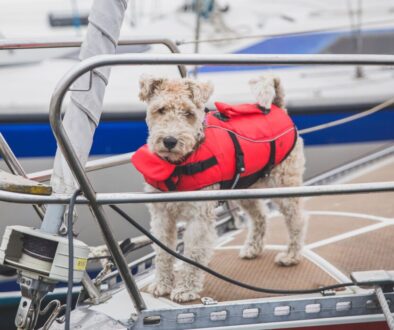
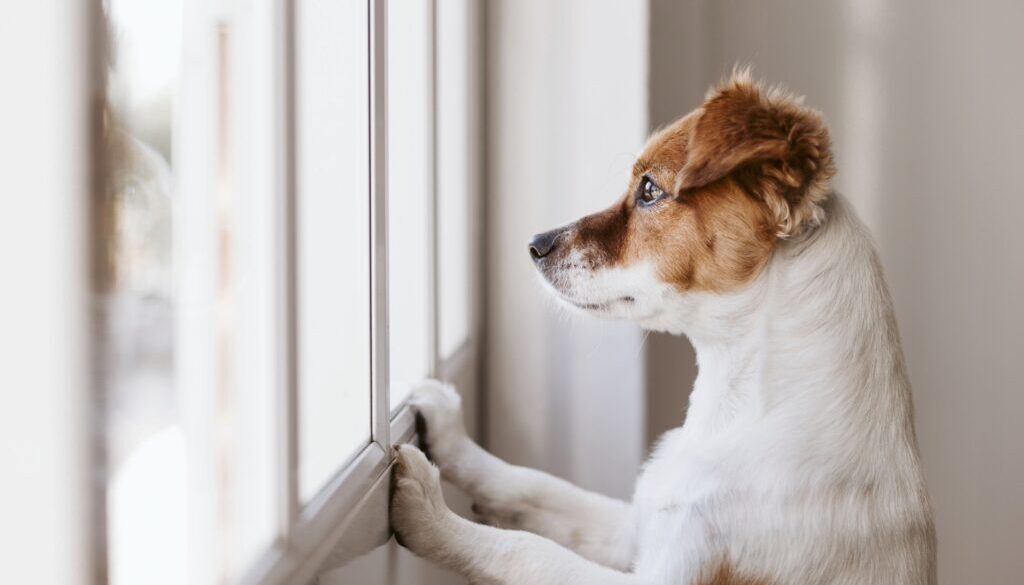
Each dog behaves differently when they are left alone.
What is dog separation anxiety?
Separation anxiety is commonly used to describe a pattern of distress that occurs when a dog is separated from a person or people to whom they are strongly attached.
Veterinary behaviour literature often uses the broader term separation-related behaviour (SRB) because not every dog displaying unwanted behaviour when alone necessarily has a clinical anxiety disorder.
Signs can include:
- Barking, whining or howling
- Pacing or restlessness
- Panting, drooling or trembling
- Scratching at doors or windows
- Chewing furniture or household objects
- Digging or attempting to escape
- Toileting indoors despite being house-trained
- Excessive salivation
- Refusing food when alone
- Destructive behaviour around exits
- Repeatedly trying to follow their owner
- Becoming extremely excited or distressed when their owner prepares to leave
- Excessive excitement when their owner returns
Some dogs show very obvious panic, while others display subtler signs such as constant pacing or being unable to settle.
A camera or old phone positioned safely in the room can be extremely useful. It allows you to see what your dog actually does after you leave rather than relying on what you find when you return. Some security cameras are cheap, easy to set up and most provide apps for mobiles so you can see your pet at home no matter where you are, some allow you to talk to your dog too!
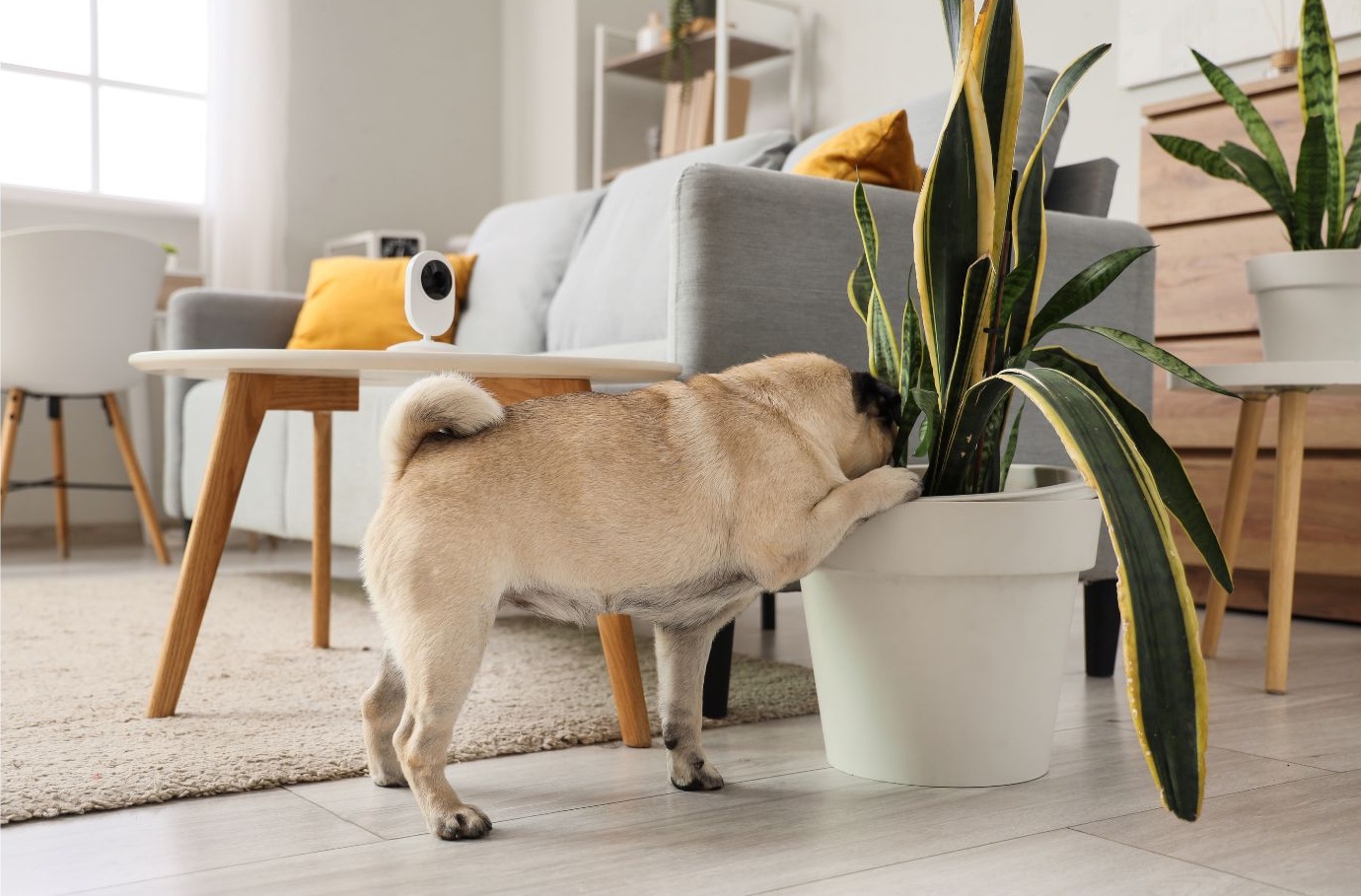
Security cameras can help you understand your dogs behaviour.
Why does separation anxiety happen?
There is no single cause.
A dog’s genetics, temperament, early-life experiences, environment, previous learning and household routine can all contribute.
Some dogs may have always found being alone difficult, while others develop problems after a major change.
Potential triggers include:
Changes in routine
Dogs can become unsettled when their normal routine changes.
For example, a dog whose owner has been home for several weeks may suddenly struggle when that person returns to work.
Research following changes in household routines during COVID-19 found an association between large reductions in dogs’ usual time alone and an increased risk of separation-related behaviour when normal routines returned.
Moving house
A new home can mean unfamiliar sounds, smells, rooms and routines. Even a confident dog may need time to adjust.
Changes in the family
The arrival or departure of a person, relationship changes, new babies, children leaving home or the loss of another pet can all affect a dog’s emotional security.
Previous frightening experiences
A dog may have learned that being alone predicts something unpleasant.
Lack of experience being alone
Dogs are social animals. A dog that has rarely experienced short, calm periods of independence may find sudden long absences particularly difficult.
Genetics and temperament
Some dogs may simply be more emotionally sensitive, highly social or prone to anxiety than others.
Rescue and rehoming
Some research has identified associations between separation-related problems and a dog’s history, although this does not mean that rescue dogs automatically develop separation anxiety. Many rescue dogs cope beautifully with being alone.
Owner behaviour
Owner behaviour plays a major role in a dogs behaviour. Quite often it is the actual owners triggering words, fussiness, over excitement and constant loving which causes a dog to develop separation anxiety. If you recognise this as part of the cause, not only does your dog need to be helped with their behaviour but you do to!
Boredom and under-stimulation
Not every dog that destroys something when left alone has separation anxiety. A young, energetic dog may simply have too much energy and not enough appropriate enrichment.
This is why identifying what the dog is actually experiencing is so important.
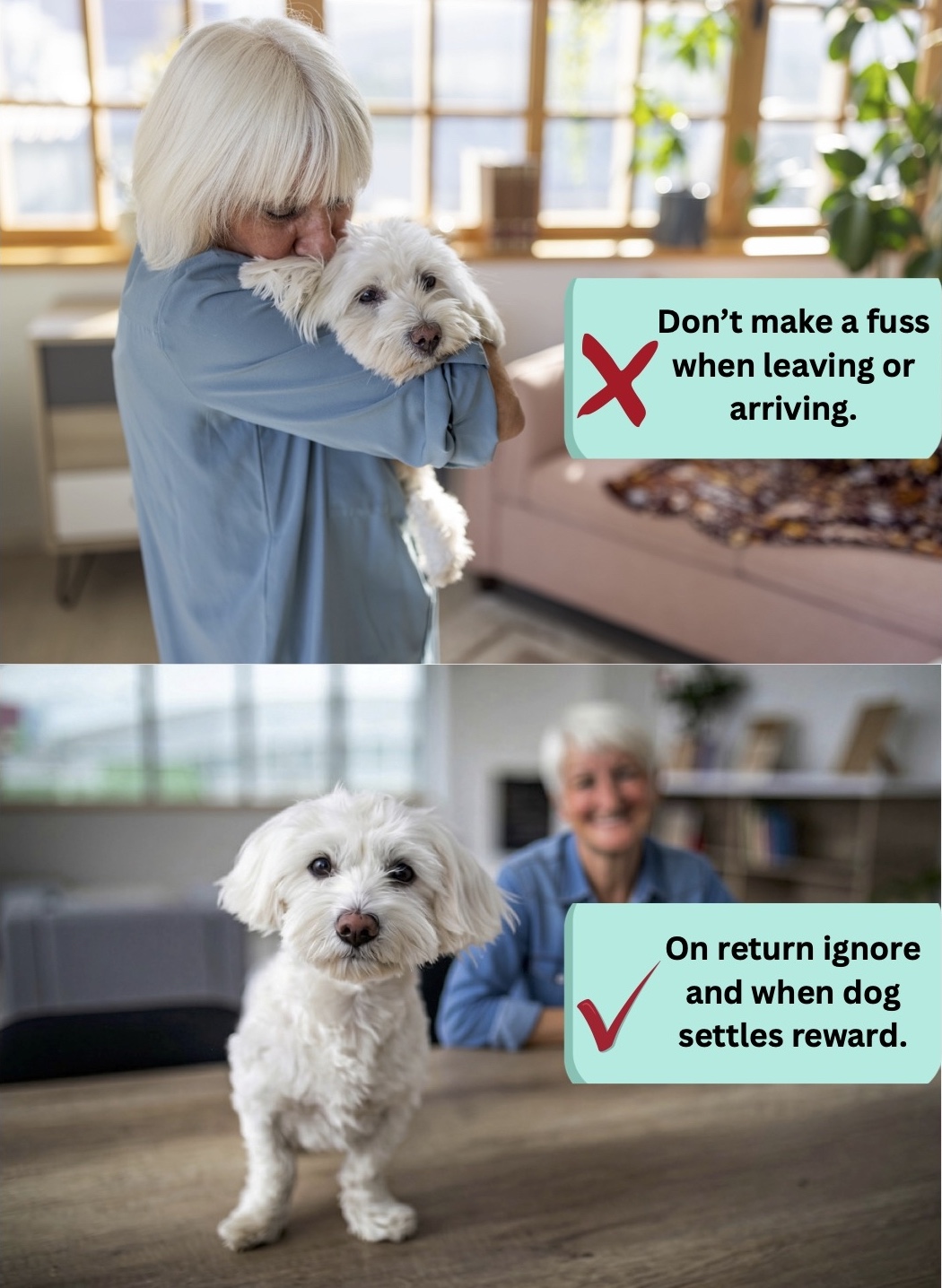
Sometimes it’s the owner that needs re-training!
Are some dog breeds more likely to develop separation anxiety?
There is no definitive list of breeds that “get separation anxiety”.
Research suggests that breed and behavioural tendencies can influence risk, but individual temperament and life experience are extremely important.
Studies have reported separation-related behaviour in breeds including:
- Labrador Retrievers
- Border Collies
- Soft-Coated Wheaten Terriers
- German Shepherd Dogs
- Cocker Spaniels
- English Springer Spaniels
- Golden Retrievers
- Oodle Breeds e.g. Cavoodles, Moodles, Groodles etc.,
- Various mixed-breed dogs
One longitudinal study following Labrador Retrievers and Border Collies found separation-related behaviour during development, with the incidence particularly high in the Labrador group studied.
A much larger Finnish study involving more than 13,000 dogs found separation-related behaviour in approximately 5% of dogs overall and identified substantial behavioural differences between breeds.
However, breed should never be used to predict an individual dog’s behaviour.
A relaxed Labrador can happily sleep all afternoon while their owner is at work, while a mixed-breed dog may experience severe distress when left alone.
Think about the individual dog first, not the breed label.
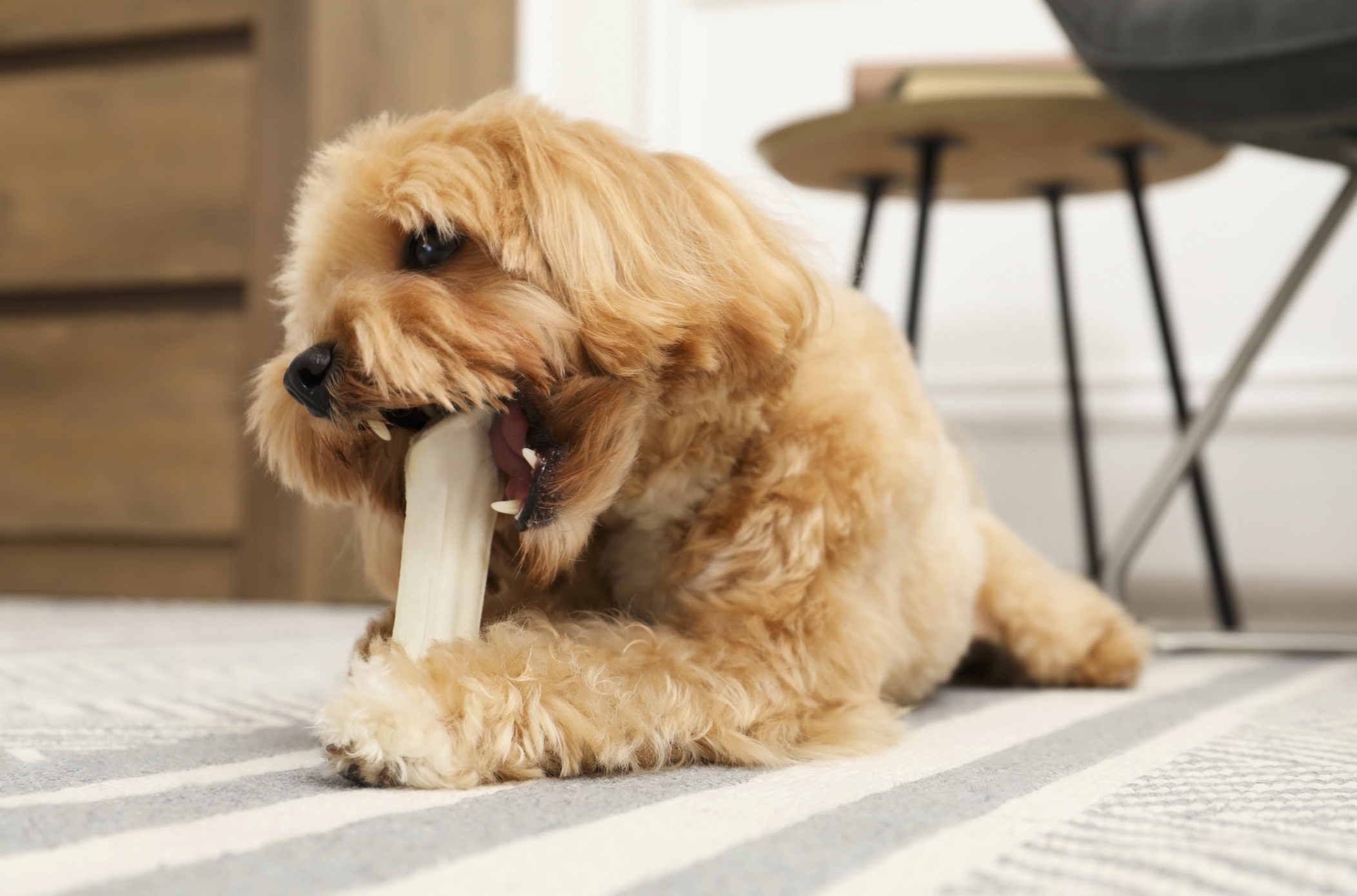
Most ‘Oodle’ breeds can be prone to separation anxiety.
The good news: dogs can learn that being alone is safe
One of the most important principles in managing separation anxiety is gradual exposure.
In veterinary behavioural medicine this is often called systematic desensitisation and counterconditioning.
The idea is simple:
We want the dog to experience being alone without becoming frightened.
Instead of suddenly leaving a distressed dog for several hours, we start at a level they can cope with and gradually increase the duration.
For example, your starting point might be just two minutes.
If your dog remains relaxed:
2 minutes → 3 minutes → 5 minutes → 7 minutes → 10 minutes → 15 minutes…
But there is an important rule:
Don’t increase the time simply because the clock says so.
Increase the duration when the dog is coping.
If your dog becomes distressed at 10 minutes, go back to a shorter period that they can manage.
The aim isn’t to test how long your dog can tolerate panic.
The aim is to teach:
“When my person leaves, they always come back — and being alone is safe.”
The “go for a coffee” training method
A practical way to gradually build independence is to use everyday activities.
For example:
- Leave your dog alone for two minutes.
- Return calmly.
- Repeat until this is easy.
- Increase the time gradually.
- When appropriate, walk around the block.
- Eventually, go and have a quick coffee.
- Gradually build towards longer periods.
For dogs with significant separation anxiety, the initial periods may need to be much shorter.
The trick is to make the dog believe you have genuinely gone while still being close enough to monitor what is happening.
For example, you might step outside and sit quietly where you can hear the dog, use a safe camera, or briefly go somewhere nearby.
This allows you to observe whether your dog is settling without immediately jumping to long absences.
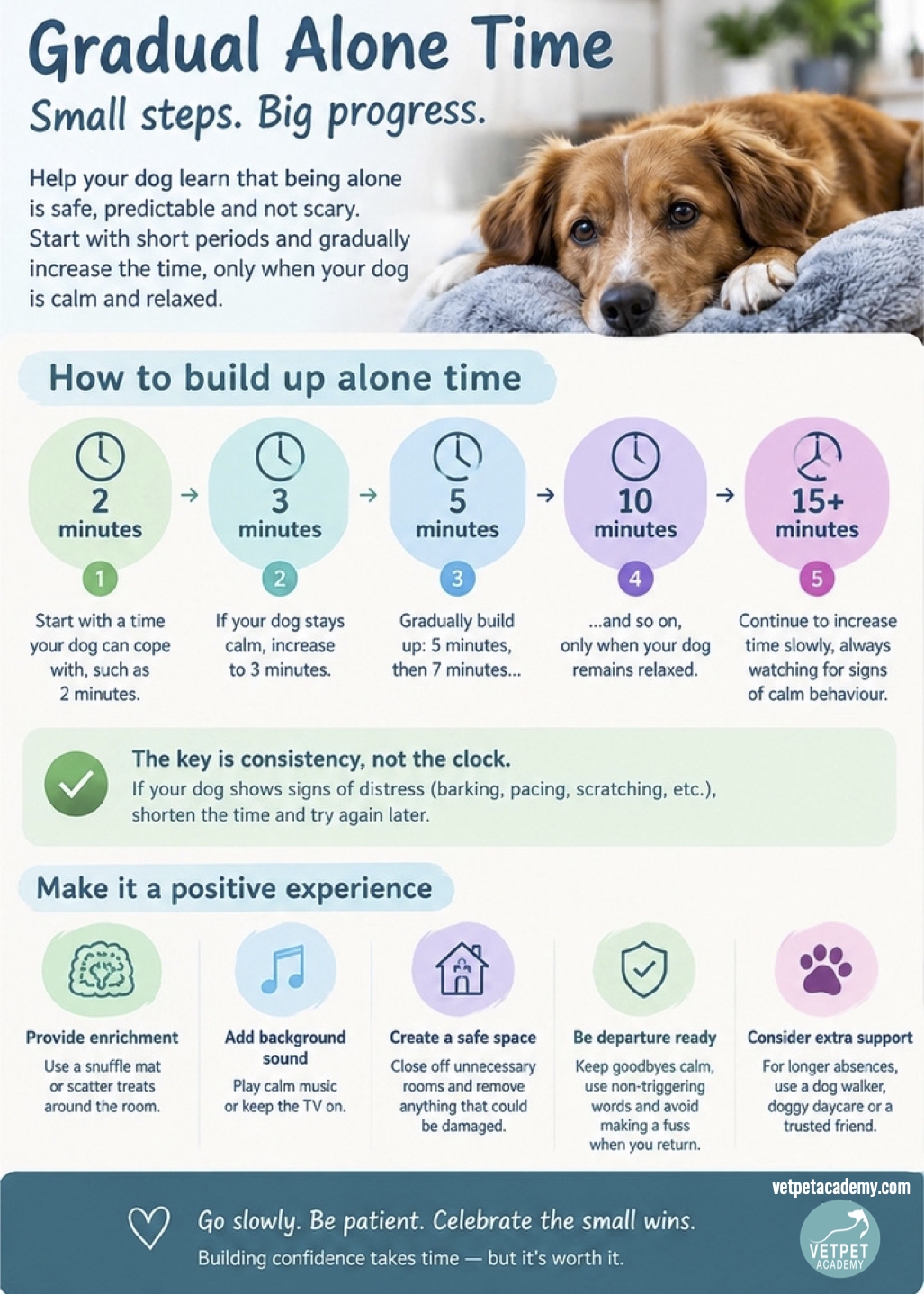
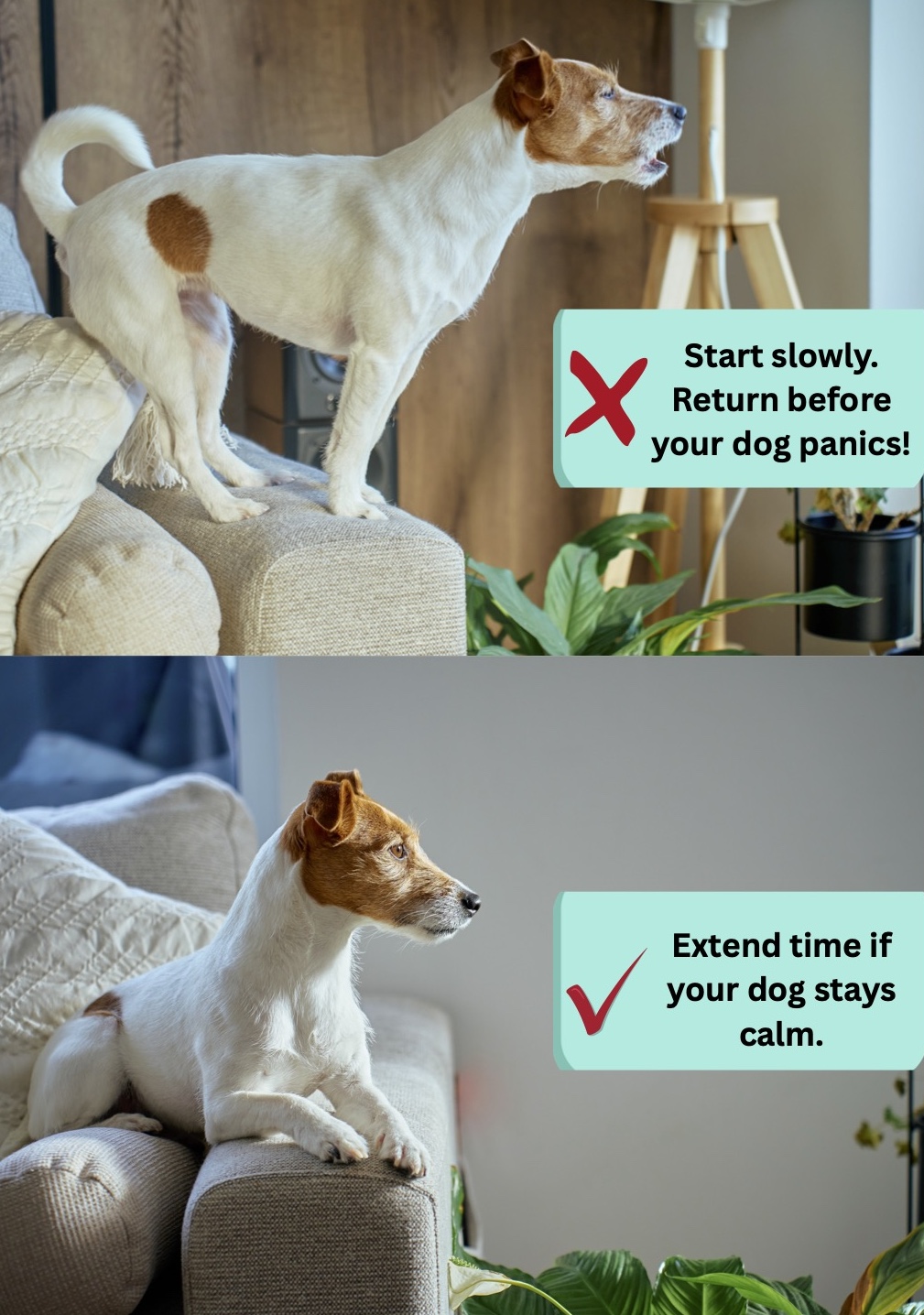
You can download the above by clicking here.
Don’t wait for your dog to panic
This is one of the most important points.
If your dog begins barking, pacing frantically, scratching at doors or attempting to escape, the training session has probably gone beyond their current comfort level.
Going back to a shorter absence isn’t failure.
It is good training.
Behaviour change takes time. Dogs learn best when they can remain emotionally calm enough to process the experience.
Remember to I.D your pet and your pets lead, collar and carrier (if using one).
Create a calm “I’m home alone” environment
Environmental management can make the training process much easier.
A useful combination of strategies that can be used alone or all together include:
1. Use a snuffle mat
A snuffle mat encourages dogs to use their natural sniffing and foraging behaviours.
Scatter small amounts of appropriate food through the mat and allow your dog to search for it.
Sniffing and foraging provide mental stimulation and give your dog something constructive to do.
For dogs that become distressed when alone, introduce the snuffle mat while you are still at home first.
You want the dog to learn:
Snuffle mat = good things happen = relaxing activity.
Always supervise new enrichment products initially and make sure they are appropriate for your dog’s chewing style.
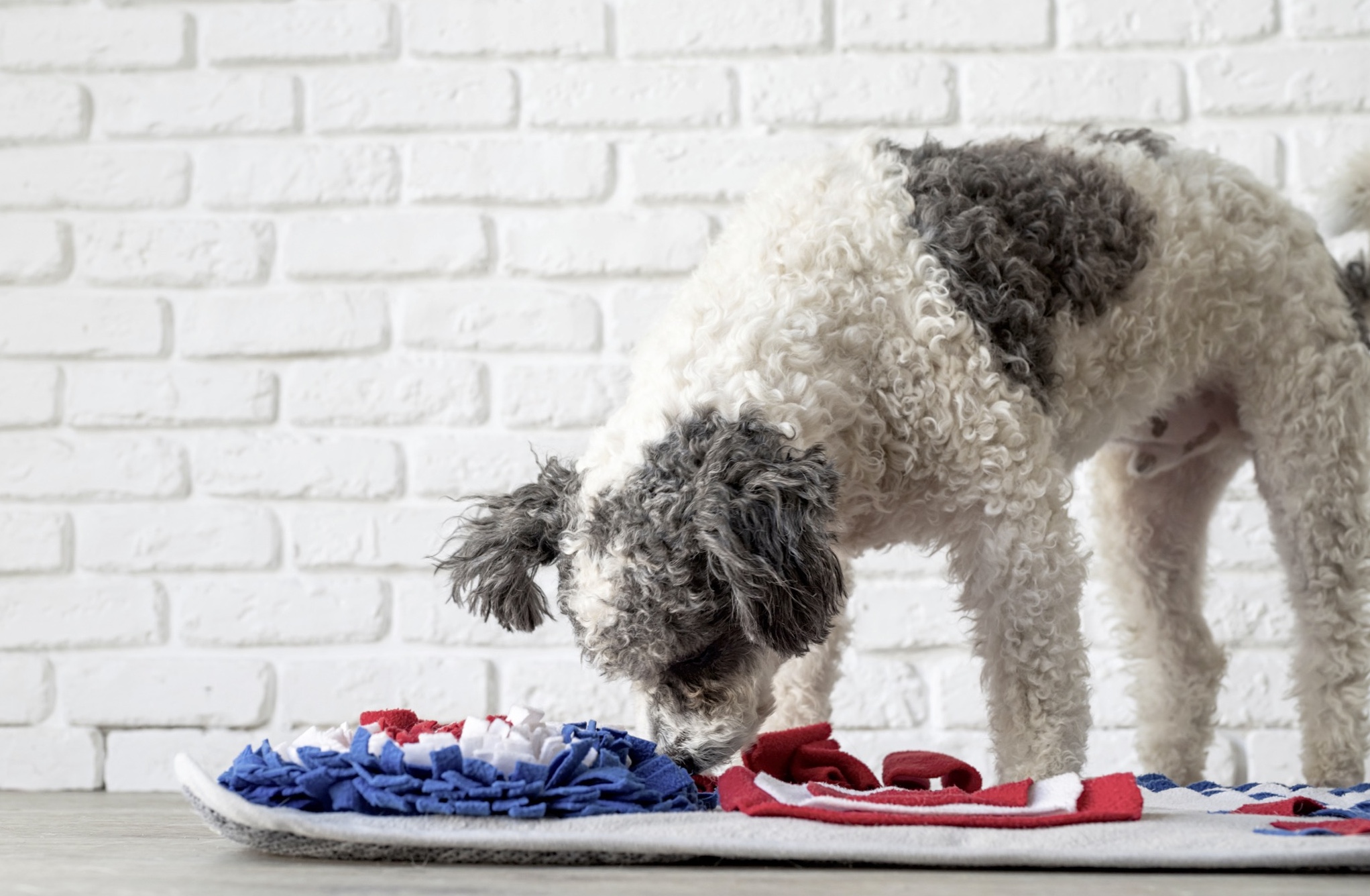
A snuffle mat is fantastic and works for all breeds.
2. Scatter treats around the room
Another inexpensive option is to scatter small treats or pieces of your dog’s normal food around a safe area.
This encourages natural searching and foraging.
You can use the same idea with part of the dog’s daily food allowance, meaning you don’t necessarily need to buy extra treats.
For dogs that enjoy sniffing, a simple “find it” game can be a wonderful way to occupy their brain.
Take a look at VetPet Academy’s easy to make dog treat recipes free in their lifestyle magazine or get them all if you become a member.
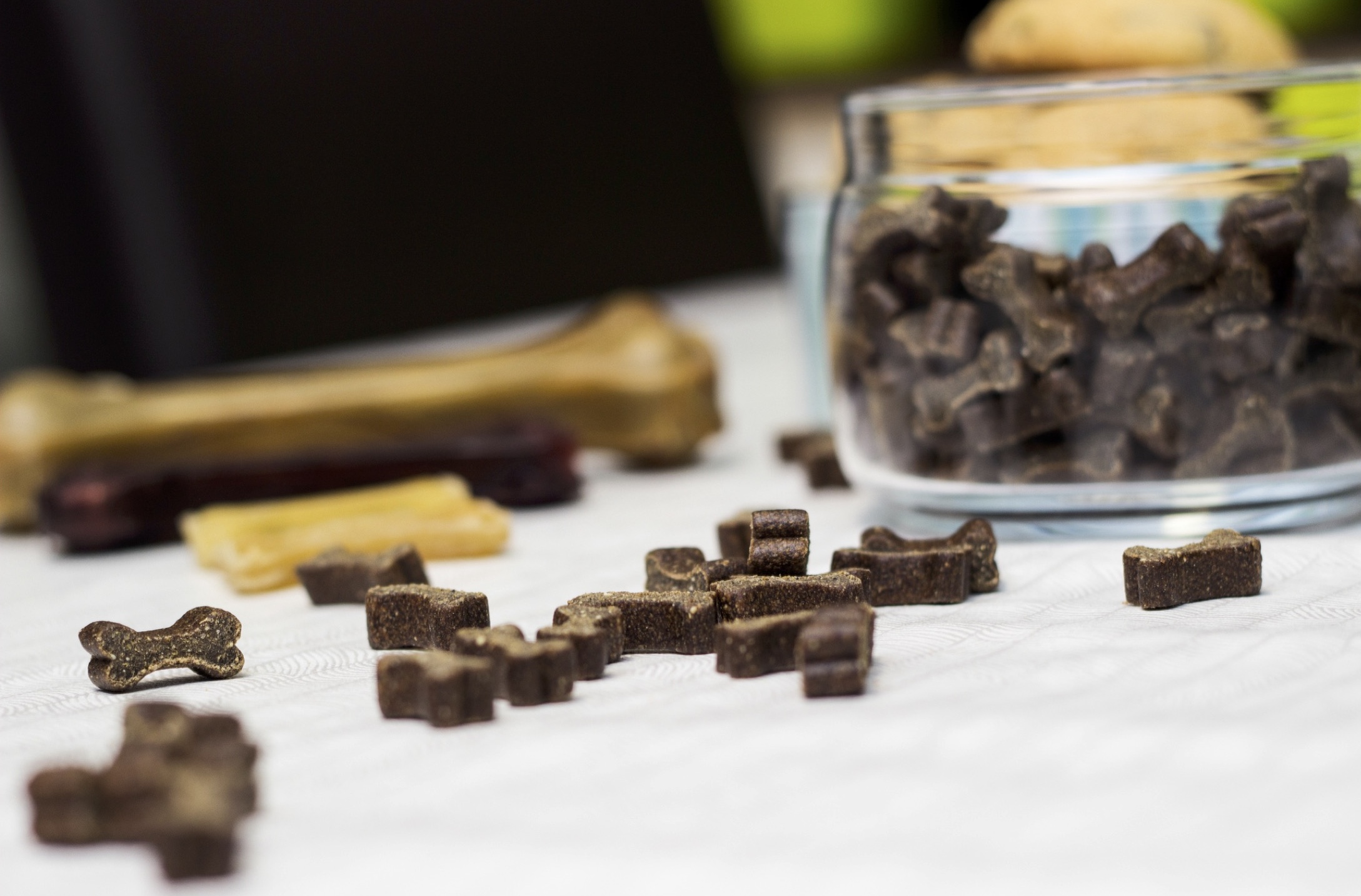
Homemade or purchased treats can be scattered around plus used in a snuffle mat.
3. Leave music or the television on
Some dogs appear more comfortable when there is gentle background sound.
Leaving the radio, television or suitable music playing can help make the house feel less unusually quiet and may mask some outside noises.
Choose something calm and predictable.
This isn’t a cure for separation anxiety, but it can form part of a wider management plan.

4. Close off unnecessary rooms
Dogs don’t always need access to the entire house while they are learning to cope alone.
A comfortable, familiar area can sometimes feel more secure.
Close doors to rooms containing valuable furniture, cables, rubbish bins or other hazards.
However, don’t assume that confinement automatically makes an anxious dog feel safer.
For some dogs, being physically restricted can make anxiety considerably worse.
5. Remove things your dog might damage
Before leaving, think like a curious or anxious dog.
Put away:
- Shoes
- Remote controls
- Children’s toys
- Electrical cables
- Bin bags
- Food
- Cleaning products
- Medications
- Fragile ornaments
- Anything that could be swallowed
This isn’t about punishing destructive behaviour.
It is about preventing accidents while your dog is learning.
What about crates?
Crate training can be extremely useful for many dogs.
But a crate is not automatically an appropriate solution for separation anxiety.
If a dog already feels frightened when left alone, putting them into a confined space can add another layer of distress: separation + confinement.
Some dogs may bark, chew the crate, injure themselves trying to escape or become increasingly distressed.
Veterinary behaviour literature recognises that separation anxiety and confinement distress can occur together.
So, if your dog is calm and comfortable in their crate, it may remain part of their normal routine.
If your dog panics in the crate, however, simply shutting the door and leaving them there is unlikely to solve the underlying problem.
The priority should be emotional safety and gradual behaviour modification, not forcing the dog to tolerate confinement.

Don’t confine your dog in their crate when you are away – it can increase stress levels.
Be careful with your departure cues
Dogs are excellent observers.
They quickly learn that certain actions predict your departure:
- Picking up your keys
- Putting on particular shoes
- Picking up your handbag
- Putting on a work uniform
- Saying “Bye!”
- Walking towards the front door
- Turning off lights
Eventually, the anxiety can begin before you have even left.
This is why “non-triggering” words and actions can be helpful.
Rather than always saying:
“Mummy’s going to work now. I’ll be back soon!”
Try “I won’t be long.”
you can keep departures calm and unremarkable.
You can also practise your departure cues without actually leaving.
Pick up your keys.
Then put them down.
Put your shoes on.
Then make a cup of tea.
Walk to the door.
Then sit back down.
This teaches the dog:
Keys do not always mean abandonment.
Why shouldn’t you make a huge fuss when you come home?
It can be tempting to walk through the door and immediately shower your dog with attention.
After all, you’ve missed them too!
However, keeping arrivals calm can help make departures and reunions less emotionally dramatic.
Simply come inside, put your belongings away and allow your dog to settle.
Once they are calm, give them attention.
This doesn’t mean ignoring your dog or withholding affection.
It means teaching them that:
Your arrival is normal. Your departure is normal. Both are safe.
Interestingly, recent longitudinal research has identified an association between owners fussing over puppies’ unwanted behaviour after returning home and later separation-related behaviour. The researchers stress that these findings are correlational rather than proof of cause and effect, but they support the broader principle of keeping reunions calm and avoiding punishment.
Use calm words — and don’t make leaving a big event
Try choosing a neutral phrase that your dog doesn’t associate exclusively with anxiety.
Something simple such as:
“See you later.”
Say it calmly and continue with your normal routine.
You don’t need an emotional goodbye.
Likewise, avoid dramatic reassurance such as:
“Don’t worry! I’ll be back! Don’t be sad! Be a good boy!”
Your dog doesn’t understand the words in the same way we do, but they are highly sensitive to your tone, body language and emotional state.
Calm communication helps keep the departure routine predictable.
Can massage help an anxious dog?
Gentle canine massage can be a useful supportive relaxation activity for dogs that enjoy being touched.
Massage should not be presented as a cure for separation anxiety, but relaxation-focused touch may help some dogs become more comfortable and settled.
Research into canine massage and tactile interaction has identified potential effects on stress-related measures, although the evidence base is still developing and massage should be considered an adjunct rather than a replacement for behaviour modification.
Try gentle, slow strokes when your dog is already calm.
Never force a dog to accept massage.
Look for relaxed body language such as:
- Soft eyes
- Relaxed facial muscles
- Loose body posture
- Choosing to remain with you
- Slow breathing
If your dog moves away, becomes tense or appears uncomfortable, stop.
For owners and canine professionals who would like to learn more about safe canine massage techniques, VetPet Academy’s Introduction to Canine Massage Therapy Course provides practical education covering canine massage, relaxation and wellbeing.

Simple massage techniques can be used everyday to help calm and destress both you and your dog.
What if you have to leave your dog for a whole day?
Behaviour modification takes time, but real life doesn’t always allow us to stay home.
If your dog cannot yet cope with a long absence, try to avoid repeatedly putting them into situations that cause severe distress while you are training.
Depending on the individual dog, options may include:
Doggy daycare
A reputable doggy daycare can be an excellent option for longer periods of separation, particularly for social dogs that genuinely enjoy being around other dogs and people.
Look for a facility that:
- Conducts temperament assessments
- Has appropriate staff-to-dog ratios
- Provides rest periods
- Separates dogs appropriately
- Has clear emergency procedures
- Maintains good hygiene
- Monitors behaviour rather than simply providing unrestricted group play
- Can explain how they manage anxious or overwhelmed dogs
Not every dog enjoys daycare, so it should be selected according to the individual dog’s temperament.
A dog walker
A trusted dog walker can provide exercise, enrichment and human contact during the day.
A pet sitter
A familiar person staying with the dog may be particularly helpful for dogs that become distressed when completely alone.
Friends or family
Even a regular visit from someone the dog knows can break up a long absence.
These options are not a replacement for behavioural training, but they can help prevent the dog from repeatedly experiencing overwhelming anxiety while training is underway.

Doggy Daycare or friends and family are a great choice if you are away for long periods of time.
Prevention: helping puppies learn independence
Prevention is easier than dealing with a severe problem later.
From puppyhood, give your dog opportunities to learn that:
being alone is normal and temporary.
That doesn’t mean leaving a puppy alone for hours.
Instead:
- Provide short, positive periods of independence.
- Let your puppy sleep and rest undisturbed.
- Give appropriate enrichment activities.
- Encourage calm behaviour.
- Allow your puppy to experience different environments and people.
- Avoid punishment for anxious behaviour.
- Build independence gradually.
- Keep household routines reasonably predictable.
- Teach your puppy that you can leave and return without drama.
Early experiences matter, but there is no “perfect puppy formula”. Dogs can develop separation-related problems at different ages and for many different reasons.

Provide a comfortable place to sleep and various types of toys to keep your dog happy.
What NOT to do
Avoid:
Punishing destructive behaviour
Your dog isn’t destroying the sofa to “get revenge”.
Punishment after you return can increase fear and may make future absences more difficult.
Suddenly leaving for hours
A dog that panics after five minutes cannot learn that being alone is safe by being left for five hours.
Forcing a frightened dog into a crate
If confinement increases distress, it can make the situation worse.
Making departures emotional
Keep them predictable and boring.
Making reunions wildly exciting
Calm arrivals can help reduce the emotional contrast between being together and being apart.
Ignoring severe distress
If your dog is injuring themselves, attempting to escape, vomiting, repeatedly toileting, refusing food, or showing extreme panic, seek professional help.
When should you speak to your veterinarian?
Veterinary support is particularly important when anxiety is severe or has appeared suddenly.
Your veterinarian can help rule out medical issues that may contribute to behavioural changes and can advise whether referral to a qualified veterinary behaviour professional is appropriate.
In some serious cases, medication can be used alongside behaviour modification.
Medication isn’t a failure.
For some dogs, reducing the intensity of anxiety allows them to learn the new behaviour more effectively.
The aim is not simply to sedate the dog. Appropriate veterinary treatment should be part of an individualised plan designed to improve welfare and help the dog cope.
A simple separation-anxiety plan
If your dog has mild separation-related behaviour, try combining several of these strategies:
Before you leave
✓ Provide appropriate exercise and sniffing opportunities
✓ Offer a snuffle mat or scatter-feed some of their normal food
✓ Make sure water is available
✓ Remove unsafe or valuable objects
✓ Close off unnecessary rooms
✓ Leave calm background music or television if your dog responds well to it
✓ Use a neutral departure phrase
✓ Leave calmly
While you are training
✓ Start with a short absence your dog can cope with
✓ Monitor using a camera if possible
✓ Increase the duration gradually
✓ Return before the dog becomes distressed
✓ Practise departure cues without always leaving
✓ Use daycare, a dog walker, sitter or trusted friend when longer absences are unavoidable
When you return
✓ Come in calmly
✓ Put your belongings away
✓ Allow your dog to settle
✓ Give attention once they are calm
✓ Avoid punishment for anything they have done while alone
Most importantly:
Go slowly.
Two calm minutes is much more valuable than twenty minutes of panic.

If buying treats or larger chewies make sure they are safe, non-toxic and the correct type for your dog.
How long does it take to overcome separation anxiety?
There is no universal timeline.
Some dogs improve within weeks. Others need months of carefully managed training.
The severity of the problem, how long it has existed, the dog’s temperament, the owner’s circumstances and whether professional support or medication is required can all affect progress.
Think of it as building confidence rather than correcting “bad behaviour”.
With consistent training, many dogs become much more comfortable spending time alone.
And even when a dog doesn’t become completely relaxed about long periods alone, good management can dramatically improve their quality of life.
Keep learning about canine behaviour with VetPet Academy
Understanding why dogs behave the way they do is one of the best tools an owner or canine professional can have.
The VetPet Academy dog blog provides practical information on canine behaviour, health, wellbeing, first aid and everyday care, written to make professional knowledge easier to understand and apply.
A great place to start is “Understanding Dog Behaviour: 30 Interesting Facts”, which explores behaviours including chewing, barking, digging, escaping, settling when alone and other common challenges.
For those interested in learning practical canine massage techniques, the VetPet Academy Introduction to Canine Massage Therapy Course explores safe massage techniques designed to support muscle health, relaxation, wellbeing and the human-dog bond.
VetPet Academy’s courses are designed for both dedicated dog owners and people working in the animal-care industry.
The most important thing to remember
Separation anxiety isn’t your dog being naughty.
It isn’t stubbornness.
And it certainly isn’t revenge.
It is a behaviour that can reflect genuine emotional distress.
The solution is usually not expensive equipment or complicated gadgets.
It is understanding, management, enrichment, gradual training, consistency and patience.
Give your dog small successes.
Make being alone predictable.
Keep departures and arrivals calm.
And remember that changing behaviour takes time.
Your dog isn’t giving you a hard time.
Your dog may be having a hard time — and with the right support, you can help them feel safer.

A relaxed pet in a relaxed environment is always a blessing.
References and further reading
- Sargisson, R.J. (2014). Canine separation anxiety: strategies for treatment and management. Veterinary Medicine: Research and Reports, 5, 143–151.
- Bradshaw, J.W.S., McPherson, J.A., Casey, R.A. & Larter, I.S. (2002). Aetiology of separation-related behaviour in domestic dogs. Veterinary Record, 151(2), 43–46.
- Overall, K.L. & Dyer, D. (2005). Enrichment strategies for dogs. Veterinary Clinics of North America: Small Animal Practice.
- Ballantyne, K.C. (2018). Separation, Confinement, or Noises: What Is Scaring That Dog? Veterinary Clinics of North America: Small Animal Practice, 48(3), 367–386.
- Harvey, N.D. et al. (2022). Impact of Changes in Time Left Alone on Separation-Related Behaviour in UK Pet Dogs. Animals.
- Tiira, K. et al. (2020). Prevalence, comorbidity, and breed differences in canine anxiety in 13,700 Finnish pet dogs. Scientific Reports, 10.
- Canine separation-related behaviour at six months of age: Dog, owner and early-life risk factors identified using the Generation Pup longitudinal study (2024).
- Desensitization and Counterconditioning: When and How? Veterinary Clinics of North America: Small Animal Practice.
- Small Animal Massage Therapy: A Brief Review and Relevant Observations. Journal of Alternative and Complementary Medicine.
- Riley, L.M. et al. (2021). Effect of massage therapy on pain and quality of life in dogs: A cross sectional study. Veterinary Record.
Professional note: This article provides general educational information and is not intended to diagnose or treat an individual dog. Dogs showing severe anxiety, self-injury, escape attempts or sudden behavioural changes should be assessed by a veterinarian.